



























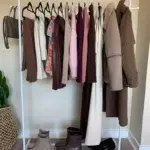





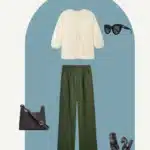









The most comfortable boots for walking all day usually look like it. These two pairs are actually stylish. One is a leather kitten heel, the other a faux suede block heel, and I’ve worn them almost daily, one for a year and a half and the other for a year, without either one reading as a “comfort boot.”
I get my steps in, so they’ve been tested properly. This past October I averaged 11,457 steps a day, and more than half of those happened in boots, hauling around the city to errands, dinners, and the endless string of gatherings that materialize once the holidays get close.
Below is what all those miles taught me: which boots are comfortable for real distance, which are built well enough to last, and which actually look good, plus how each pair held up and which one I’d buy again.

Naturalizer Deesha Boots Review

October 2025, seven months in.
I ordered these in February 2025, sent them back, and ordered the same size and color again two weeks later.
I was in the midst of trying out multiple boots and was on the fence about the Naturalizers, but in the end they became a staple.
How they fit, and the size I’d actually tell you to buy
I’m usually an 8 to 8.5 and took the 8.5. When I first tried them on, the toe box felt faintly tight, enough that I wasn’t sure I’d gotten it right, so I returned the first pair before committing.
It turned out fine. The leather gave exactly as much as it needed to and never pinched again. But knowing what I know now, I could have worn the 9, and I’m almost never a 9 in anything. On the spectrum of narrow to wide, my feet sit in the middle with a slight lean toward wide, and boots are usually where I feel it.
My sizing advice:
- Between sizes, or feet that lean wide at all? Take the larger one.
- Anything other than a slim calf? Get the wide calf version. The standard shaft sits close to my leg, nearly touching, and my legs are slim.
- Tucking in jeans? A skinny jean works. Nothing wider will.
Naturalizer makes a wide calf version of this boot for a reason. If you’ve ever had a knee-high boot refuse to zip, buy that one instead.
What they’re made of
- Upper: leather
- Lining: recycled polyester
- Outsole: synthetic rubber
- Closure: side zip with a hidden gore panel
What I now know: the outsole is a single cemented unit, so there’s no welt and no true resole in this boot’s future. A cobbler can replace heel tips and add protective pieces. He cannot rebuild the sole.
That’s the trade you make at this price, and it’s one I’m okay with.
How they look after a year and a half
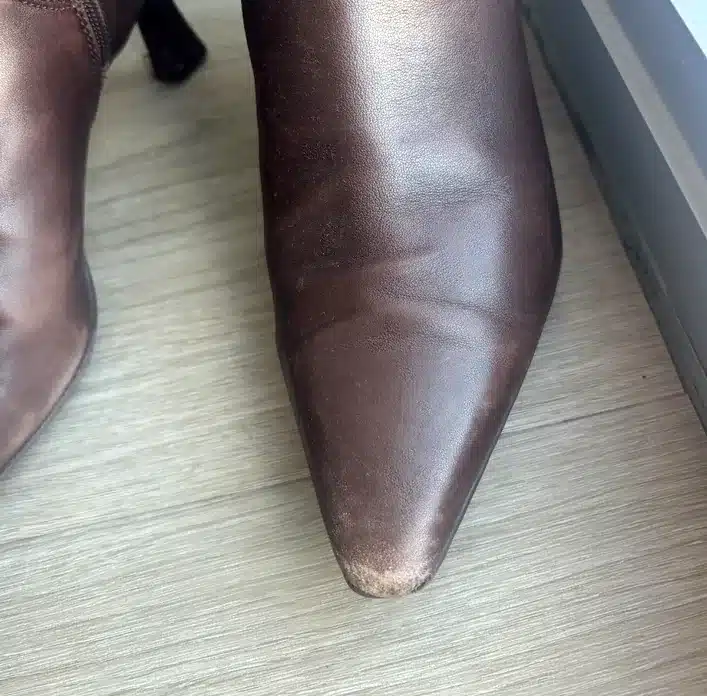
The toe finish rubbed through at around six months.
The toe finish rubbed through at around six months. You can see it in the photo, a pale patch where the color has gone. If you actually walk in your boots, this is going to happen, and it happened faster than I expected on a $200 pair.
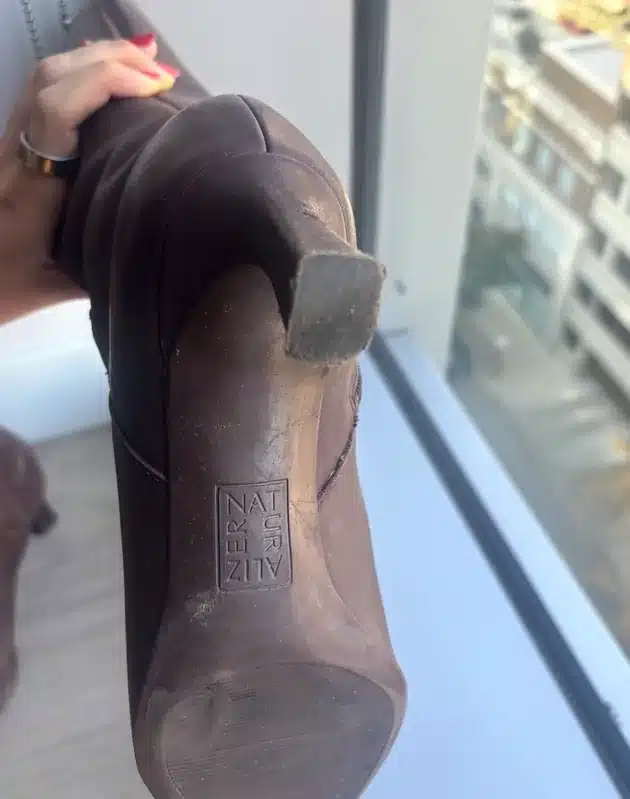
The heel tip, worn down and rounded off at the back edge.
The heel tip wore down and rounded off at the back edge. The leather itself held up, creasing in a fan pattern across the instep, which is just what leather does when you bend it ten thousand times.
Everything wrong with this boot was cosmetic. The cobbler:
- Repolished the toes
- Replaced the heel tips
- Added a small protective tap at the point of the toe to stop the same thing happening again
They look close to new.
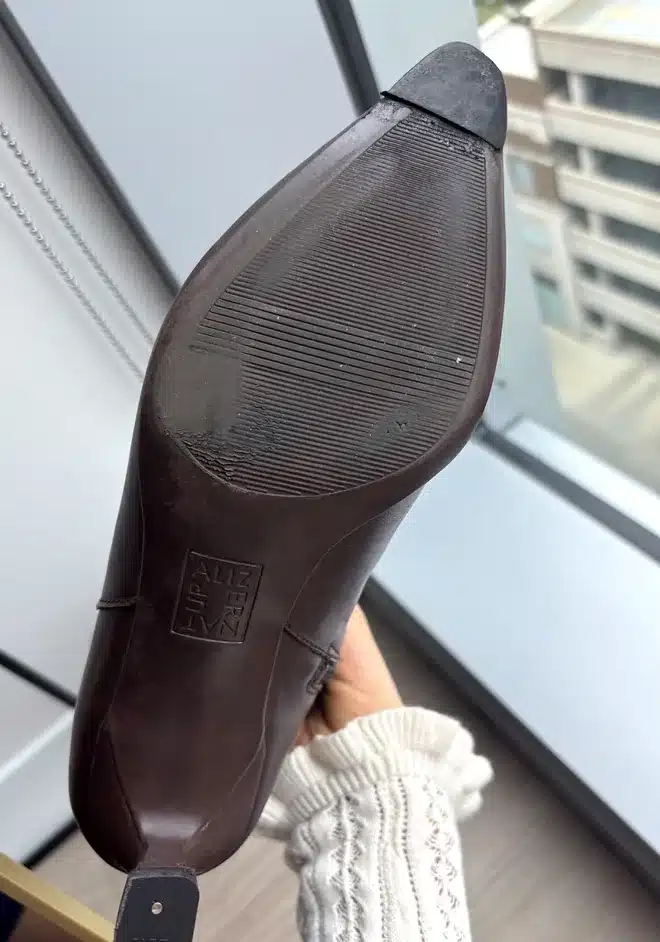
Back from the cobbler with a new toe tap and heel tip.
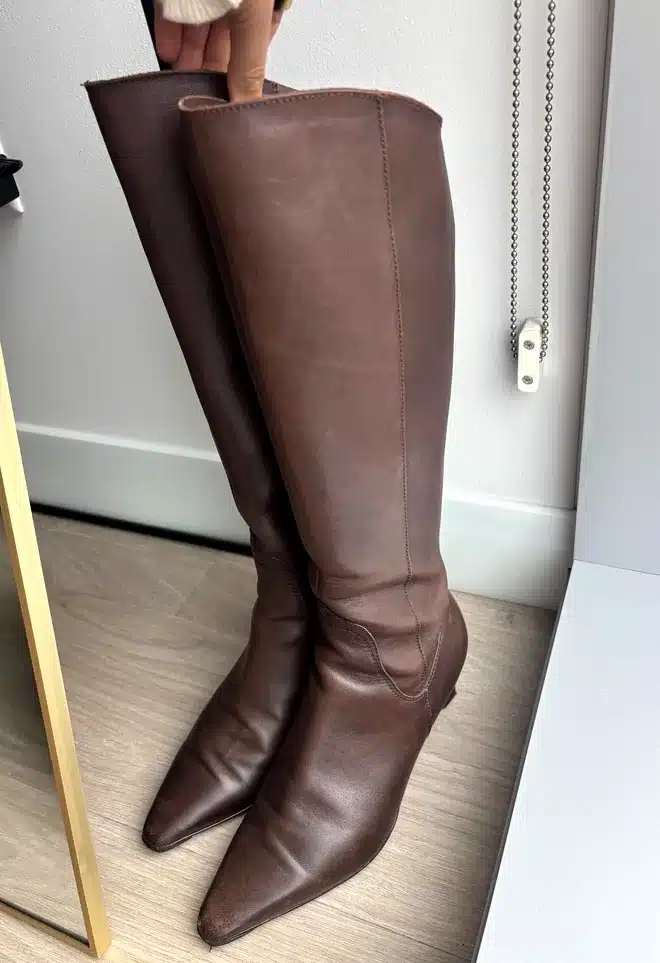
After the repair. They look close to new.
Who should buy these
- Slim calves, or anyone buying the wide calf version
- Anyone who loves a pointed toe
- Anyone willing to visit a cobbler once a year
The kitten heel is low enough to walk in and tall enough to change the line of your leg, which is the entire reason I own them. I’ve worn them with a denim midi skirt, a belted mini dress, and a pleated brown dress, and I’m glad I ended up selecting them.
Aerosoles Micah Boots Review

The Micah in Java faux suede.
Bought November 2025 for $149, in Java faux suede.
How they fit
Same 8.5, and comfortable from the first wear with no tight spots anywhere.
The stretch panel is the reason these feel so comfortable. It’s why a slightly wide foot is happy in a medium width. A structured leather shaft wouldn’t have given me that.
The shaft hits a couple of inches below the kneecap, same as the Deesha. Neither pair cuts across the widest part of my calf, which is the usual way knee-highs go wrong on a shorter frame.
What they’re made of
- Upper: faux suede with stretch
- Heel: 2.75 inch block
- Outsole: what Aerosoles calls a diamond flex outsole
- Insole: the listing contradicts itself, with Ortholite in the description and memory foam in the details
How they look after a year
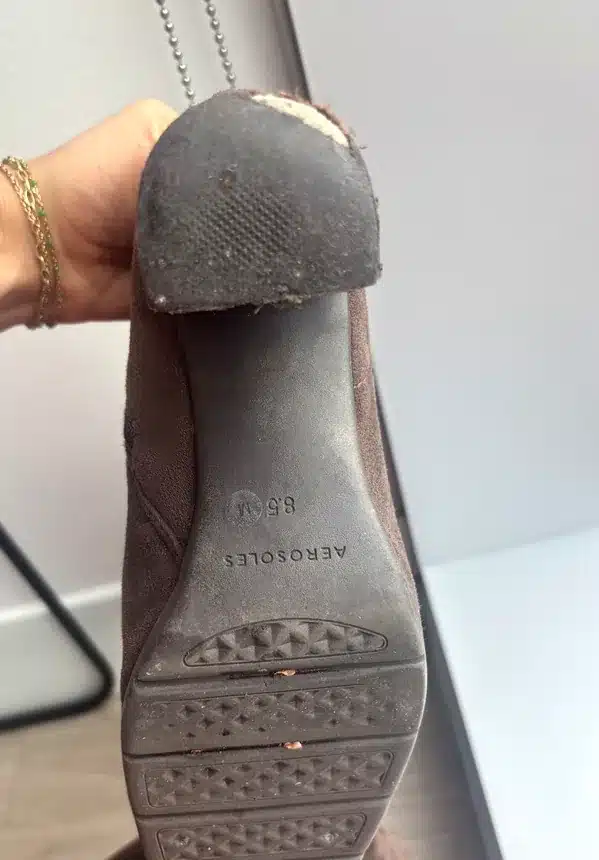
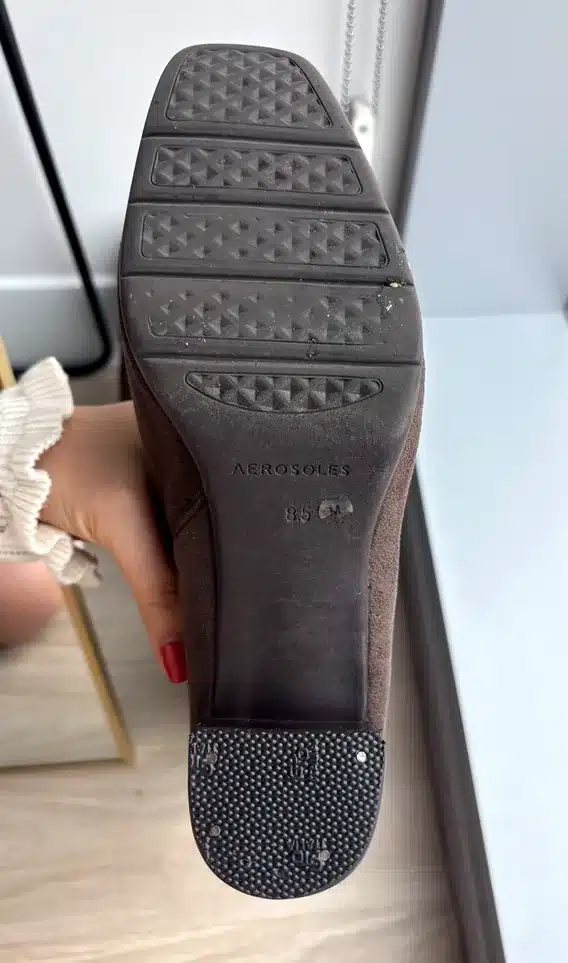
Worn through to the core at the back outer corner.
The heel didn’t wear down. It wore through.
There’s still black rubber in the middle of the heel piece, then a pale crescent at the back outer corner where the rubber is gone entirely and you’re walking on the core. What used to be a soft step turned into an audible clip against the sidewalk.
The forefoot tread, meanwhile, is almost untouched. The diamond pattern across the ball of the foot is all still there. So the rest of the boot handled the walking just fine. All the wear landed on the one spot that takes the heel strike, and that’s an easy fix for any cobbler.
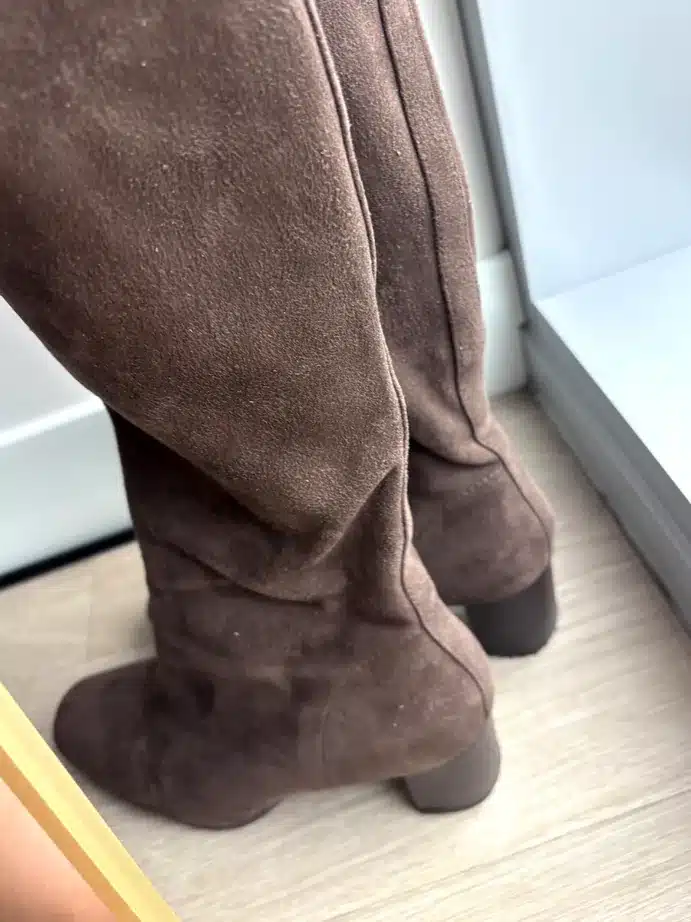
The faux suede nap, matted flat at the flex points.
The cobbler replaced the heel caps and the sound went away.
A new heel cap, and the clip on the sidewalk went away.
Who should buy these
- Anyone who needs a boot for actual distance
- Anyone with a slightly wide foot
- Anyone who’d rather spend $149 and budget for a heel repair than spend $200 up front
Go in knowing the suede will flatten and won’t be restorable.
I haven’t tested these in heavy salt. Chicago winter salt is hard on faux suede, and this piece doesn’t answer that question yet.
The Four Pairs That Went Back

The Deesha, the one pair out of five that made the cut.
In three weeks in early 2025 I ordered five pairs of knee-high boots and returned four. The Deesha only won by comparison, so here’s what was wrong with the rest.
Sam Edelman Sylvia: stiff leather, half zip. Beautiful boot. But the leather felt stiff in a way that didn’t suggest it would soften, and the half zipper made getting in and out genuinely annoying compared to the full side zip on both pairs I kept. A zipper sounds like a small thing until you’re doing it twice a day.
Franco Sarto Tribute: felt off in hand. It looked remarkably like the Micah but felt off in a way I couldn’t quite name. I didn’t wear them long enough to find out whether that instinct was right. For what it’s worth, the review pattern on the listing runs toward complaints about the material separating and cracking at the toe bend, though some of those appear to be other styles in the same family.
Madden Girl Winslow: $52, and it looked it. Costumey in a way that no amount of styling was going to fix. No complaints, though. That’s a fair boot for the money.
The first pair of Deeshas: returned over the toe box question I eventually decided I’d been wrong about.
How to Spot a Boot That Won’t Fall Apart on You
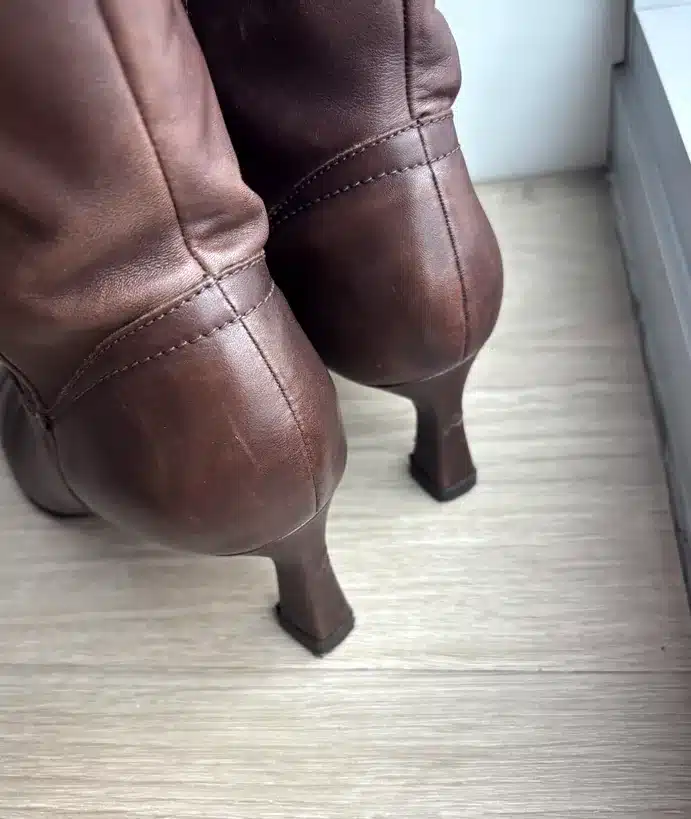
A firm heel counter, still holding its shape after a year and a half.
Three checks, in the order I’d do them. They’re boot-specific versions of the checks in how to tell if clothing is good quality.
1. Press the heel counter first
Squeeze the back of the boot where your heel sits. It should resist and hold its shape. Cardboard collapses and takes the boot’s structure with it inside a season. This takes two seconds in a store and tells you more than any spec sheet.
While you’re there, look at the toe. If it’s glossier than the rest of the upper, the leather was stretched too hard over the last, and that’s where the finish will go first.
2. “Genuine leather” is the bottom of the ladder, not the top
- Full grain: the whole hide with its surface intact.
- Corrected grain: sanded, with a finish sprayed on.
- “Genuine leather”: a grading term for the layers left after the good stuff is split off.
That last one shows up on tags most often precisely because it sounds like reassurance. The same ladder applies to handbags, which I get into in my quiet luxury bags guide.
3. Look at where the sole meets the upper
- Stitching running around the edge: the sole can usually be replaced.
- A smooth, seamless join: it’s cemented, and the sole is the boot’s lifespan.
Most women’s boots at this price are cemented. That doesn’t make them disposable. My cemented boots came back from the cobbler in good shape. It means you plan for heel tips and protective taps instead of a resole, and you stop expecting a $150 boot to behave like a $600 one.
Cushioning Isn’t What Makes a Boot Comfortable at Mile Six

The Micah with a pleated skirt and blazer.
Every brand sells comfort as foam: memory foam insole, cushioned footbed, cloud-something.
Foam compresses. A year in, the plush insole you paid for is a thin sheet with your foot’s outline pressed into it.
What’s still working at hour nine is the stuff that doesn’t squash:
- A heel that sits under your weight rather than in front of it
- A counter that holds your heel still
- A shaft that doesn’t fight your calf
Both of my pairs are comfortable for structural reasons, not soft ones. And neither of them looks orthopedic, thank goodness. The boots sold hardest on comfort tend to be the ones you’d rather not be photographed in. These went to dinners, gallery openings, and a lot of walking in between.