


























Natural fiber clothing is having more than a moment. Fabrics like cotton, linen, silk, and wool are more breathable than their synthetic counterparts and, in many cases, easier on the environment.
Whether you want natural fiber clothing for health reasons (microplastics and forever chemicals be gone), sustainability concerns, or because you’re done paying premium prices for polyester garments that aren’t comfortable, you’re not alone.
I’ve been shifting my closet toward natural fibers for the past eighteen months and I’m still somewhere in the middle of it.
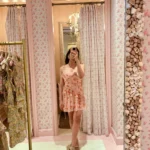
The blouse I’m wearing as I write this is Petite Studio’s Calen, and the tag says 100% cotton with nothing after it. That’s the easy case. Most labels aren’t that tidy.

My switch to natural fiber clothing has been a gradual one, filled with helpful lessons I’m sharing with you below.
Read on to learn which brands I’m shopping, the cost of pieces, and the non-overwhelming way to switch your closet to natural fibers.
I’ve tested Petite Studio pieces over the years to see how they hold up over time, and I’ve been impressed. Elegance Edit readers get 20% off with code CELESTE20. My full Petite Studio review is here.
What actually counts as a natural fiber

The main natural fibers you’ll see in clothing are the ones you’d guess: cotton, linen, wool and silk.
Grown or raised, spun into cloth, and they biodegrade at the end of their life.
Semi-Synthetic Fabrics
Then there’s the group that trips everyone up. Lyocell, Tencel (a brand name for lyocell), viscose, rayon, modal and bamboo all start as plant material and get chemically processed into fiber. They’re usually called semi-synthetics. They feel lovely, they drape beautifully, and they’re not the same thing as linen no matter how much the product photography suggests otherwise.
This isn’t just my opinion, happily. The FTC says fabric can only be called bamboo if it’s made from actual bamboo fiber. Once that bamboo has been processed into rayon, the label legally has to say rayon.
And they enforce it. Four retailers paid a combined $1.26 million in penalties back in 2013 for calling rayon bamboo, and the FTC brought a bigger case against Kohl’s and Walmart in 2022.
Synthetic Fabrics
Then there’s fully synthetic: polyester, nylon, acrylic, elastane and spandex. They are petroleum-derived, aka plastic at the molecular level.
Labels to Know
Two labels are worth knowing once you start looking. Organic cotton is grown without synthetic pesticides. OEKO-TEX means the textile’s been tested for harmful substances.
My organic cotton collection currently includes a barrel sleeve pinstriped top from Gap, perfect for Zoom calls, and a girly pink pajama set I found during a late-night Etsy shopping session (we all have our addictions).
Neither of those is OEKO-TEX certified, but my $20 Quince t-shirts are. The two labels aren’t a package deal, and the cheapest thing in my closet is the one with the chemical safety testing behind it.
How I'm actually switching to natural fibers

1. I learned the fabrics first
Knowing is the whole first step, and you don’t need to be an expert to be an informed shopper.
Before I could shop differently, I had to be able to look at a label and understand what I was reading.
This is an oversimplification, but it helped me center myself when first learning:
There are four natural fibers, a handful of semi-synthetics, and the rest is plastic.
The rest I’ve picked up piece by piece. What organic cotton actually means. What OEKO-TEX certifies. Which brands use good fabrics vs. which ones are relying on a linen-adjacent photograph.
This is the list I actually run through before anything goes in a cart. Five questions, one page, free.
2. I read the composition on every piece before I buy

This is the first shift I made, and the one that’s opened my eyes to just how much clothing is made of low quality fabric.
The Reformation example is the one that taught me this. I’d assumed a brand with that reputation would be mostly natural fibers, and plenty of their tops are lyocell. That’s not a scandal. Lyocell drapes better than linen and wrinkles less, which is exactly why it’s used.
But knowing means I can weigh the price against the durability myself instead of assuming. It also means I’ve stopped being surprised at checkout, which has saved me more money than any sale.
3. I'm dipping a toe into secondhand, filtering by material

This is the newest part of my process, and I just know I’m going to find gems for my winter wardrobe.
On ThredUp, you can filter by material. So instead of searching ” pea coat” and scrolling past four hundred polyester options, I set the filter to wool and see what comes back.
The search does the fabric screening for me, which is the opposite of how I used to shop, where I’d pick the item first and find out about the fabric last.
I haven’t bought anything this way yet. What I have is a wishlist, and sitting at the top of it, quietly taunting me, is a Lafayette 148 New York wool coat listed at $492.99. ThredUp puts its retail at around $2,998.
Here’s why I like it as an example, though. The composition is 84% wool, 13% cotton, 3% polyamide. By the tiers I use below, that’s not a clean label.
What it is instead is a mostly-natural blend from a brand that constructs things properly, at a sixth of what it would’ve cost new. That’s the kind of piece the material filter is good at surfacing, and exactly the kind a strict natural-fiber-only rule would’ve made me scroll right past.
I’ve started looking at The RealReal too, though ThredUp is still where I go first, purely because the material filter is better.
4. I cleared out what was already worn out
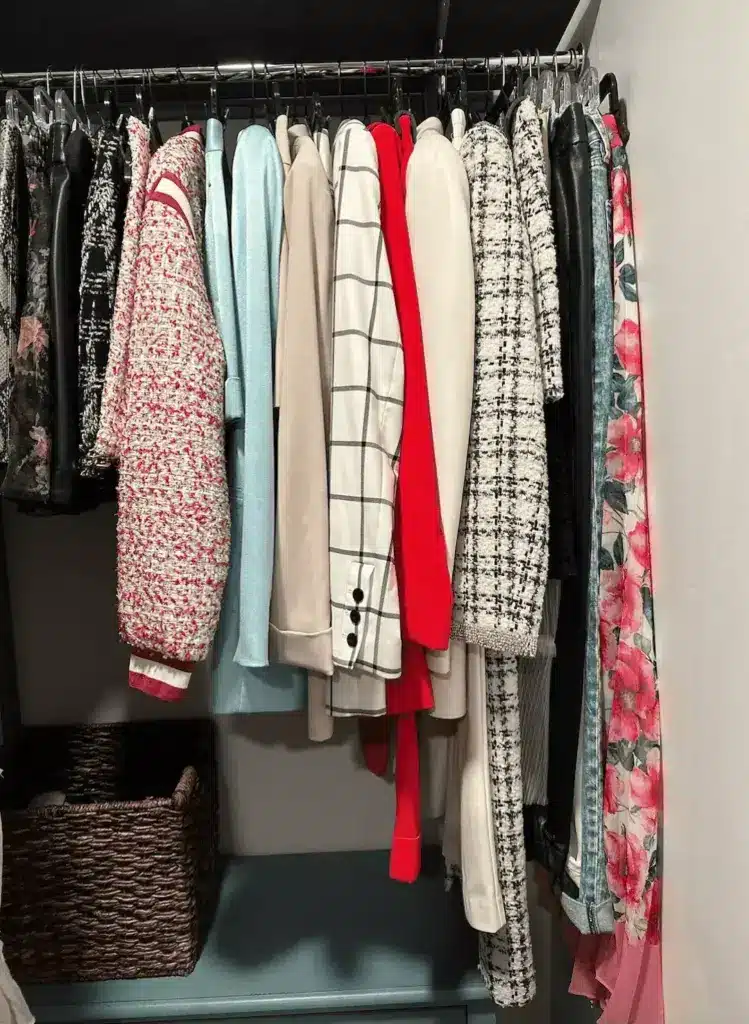
I went through my closet and pulled everything past its best. Pilled, misshapen, thin in the wrong places. A number of those pieces turned out to be majority polyester or nylon.
I took 15 pieces to Crossroads and submitted to the public humiliation ritual of a stranger going through your bag and only wanting four things. The rest I donated.
One example: a polyester blend day dress I used to wear around the house constantly. It never felt nice against my skin, and I’d worn it for months without quite admitting that. Pulling it out of the pile was the moment I finally put words to what I wanted, which is fabric that wraps me pleasantly.
This closet clean-out step made the shift feel real. Importantly, I didn’t replace everything at once. Instead, I’ve gone about it intentionally.
The natural fiber clothing brands I actually wear, and what they cost
In practice, my closet sorts into three tiers, and I think that’s more honest than a strict natural-or-not divide.
Tier one: clean labels
Petite Studio, Calen Embroidered Ruffled Cotton Blouse, $140.
100% cotton. Scalloped trim, eyelet detail, and a composition line with nothing else in it.
It’s also dry clean or hand wash only, which is genuinely inconvenient for a cotton blouse and worth knowing before you order. Shop the Calen blouse with code CELESTE20. I went into more detail in my full Petite Studio review.

Gap cotton tank tops, $15. Proof that none of this requires a premium budget. I’ve had mine eighteen months and they’ve held their shape.
I should be honest about the use case, though. These are house tanks and summer errand tanks, not pieces I’m putting through hard wear. Gap runs sales constantly and their basics are frequently straightforward cotton.
Reformation Romi Silk Dress, $278. 100% silk. I’ll be honest, I don’t know yet whether it was worth it. Reformation quality has been hit and miss for me, so I’m hoping this one lands on the right side of that.
What I can tell you is the silk is delicate. It’s a 19mm charmeuse, and dry clean only feels less like an imposition than the only sensible option. I bought it in early August, so it’s been in rotation only a matter of weeks and worn a handful of times so far. I’ll report back once it’s had a real season.
Tier two: natural with a functional trace of synthetic
Petite Studio, Franny High-Rise Wide-Leg Jeans, $185. 99% cotton, 1% spandex. That 1% is doing a job. It’s what lets the jeans hold their shape through a full day instead of bagging at the knee.
A 100% cotton version of these would be a worse pair of jeans, and I say that as someone whose whole premise here is fewer synthetics.

Gap denim, $60. 94% cotton, 5% recycled cotton, 1% elastane. Same principle at a third of the price, and the recycled cotton is a nice little bonus. Gap is on sale often enough that $60 is a realistic price rather than a lucky one.
A year in, I still like them, but they’re not as structured as the Petite Studio pair. My guess is the recycled cotton content is why, and I suspect a higher percentage of virgin cotton would hold its shape better over time.
Quince t-shirts, $20. 91% organic cotton, 9% spandex. This is where my own line gets tested. Nine percent is meaningfully more than one percent, and I wouldn’t want that ratio in something I expected to keep for a decade.
I keep them anyway, for two reasons. Organic cotton at that price is hard to argue with, and a tee with a bit of recovery holds its neckline instead of going slack at the collar. Eight months in, mine still sit properly.
They’re also the only OEKO-TEX certified pieces I own, which I did not expect from the cheapest thing on this list. Shop Quince
Tier three: semi-synthetic, chosen anyway

Marcella NYC, Cooper Top, $90. 96% Tencel, 4% elastane.
By a strict definition this top contains no natural fiber at all. Tencel is a processed plant fiber and elastane is plastic. And it’s one of my favorite things I own.
It’s an off-the-shoulder style, and off-the-shoulder only works if the fabric stays where you put it. Without the stretch it would slide around all evening and I’d spend the whole night adjusting it. The Tencel gives it a drape that cotton jersey just can’t do at this weight.
I’ve had mine two years. The real endorsement is that I bought a second one in slate gray a few months ago, and I don’t do that often.
I include it because pretending my closet is 100% natural would be a lie, and because it makes my point better than any of the clean labels do. The goal is clothes that work and last. Sometimes the fabric that achieves that isn’t the purest one on the shelf.
Where a little synthetic earns its place
My rule, such as it is: the synthetic has to be doing a job I actually want done.
One percent elastane in jeans so they hold their shape? Yes. Four percent in a top whose whole silhouette depends on it? Yes. Sixty percent polyester in a sweater because it’s cheaper to produce? No, because nothing’s being solved for me there.
I’m stricter with basics than with anything else. A white tee, a knit, a pair of trousers I’ll wear weekly for years, those I want as close to pure as I can get, because those are the pieces where fiber quality shows up as longevity. With a statement piece I’m much more relaxed.
The part where I’m not switching: activewear
I own a lot of leggings that aren’t natural fiber. I bought them before I’d thought about any of this, and I still wear them.
I’d like to move toward organic cotton sets and I’ve been researching brands, which will be its own piece. But in the meantime I’m not throwing out a drawer of perfectly functional gym clothes to buy all new ones. That isn’t the sustainable choice, it’s just a different kind of consumption with better branding.
This is the part of the natural fiber conversation I find least honest. The most sustainable garment is almost always the one you already own. Wearing out what you have isn’t a compromise on the way to a better closet. It’s the point.
Where to buy natural fiber clothing
Secondhand, filtered by material. ThredUp’s material filter is the fastest way I’ve found to shop this way. Set it to wool, linen, silk or cotton and let the platform do the screening for you.
Rent before you commit. If you’re not sure whether a fabric suits your life, renting lets you live in it for a month before deciding. I’ve written about BNTO vs Nuuly and Rent the Runway in more detail.
Check the composition on every site, every time. Including the ones you trust. Especially the ones you trust.
And if you’re building from scratch rather than replacing piece by piece, my guide to building a capsule wardrobe that lasts is where I’d start.
Note: Everything here is something I own and have worn. Petite Studio gifted me two pieces, and those links are affiliate. Everything else I bought myself. Nothing’s in here that I haven’t put through a wash.
FAQ
Cotton, linen, wool and silk. Lyocell, Tencel, viscose, rayon, modal and bamboo are semi-synthetic: plant-derived but chemically processed. Polyester, nylon, acrylic and elastane are fully synthetic.
Not necessarily. The pieces I’ve found range from $15 for Gap cotton tanks to $278 for a Reformation silk dress. Secondhand closes the gap even further. The Lafayette 148 wool coat on my wishlist is listed at $492.99 against an estimated $2,998 retail.
It means the fabric’s been tested for harmful substances, and not much else. OEKO-TEX Standard 100 checks every component, thread and buttons included, against a list of over 1,000 substances, with tighter limits on anything made for babies. What it doesn’t tell you is whether the fiber is organic, how the garment was made, or how long it’ll last. OEKO-TEX runs separate certifications for those. It’s a chemical safety label, not a quality label.
Where I’ve landed
Shifting a closet takes time, the same way style does. I’m somewhere in the middle of it, and I expect to be for a while yet.
What’s changed isn’t that I buy only natural fibers. It’s that I know what I’m looking at now, and I can decide on purpose. Sometimes that means the 100% cotton blouse. Sometimes it means the Tencel top I love anyway.
Both are better than what I was doing before, which was not looking at all.
If you want the short version of everything above, it’s the checklist I use before I buy anything.